Safety: When Does “STOP” Mean Stop?
 A topic at the September executive board meeting was the practice of a whole group of riders rolling through an intersection controlled by a stop sign. I sent the following email to Chris Thomas of Thomas, Coon, Newton & Frost. TCNF is a local law firm that has specialized in bike issues for a long time. Chris has presented at our club meeting, as has his father, Ray Thomas, before him.
Chris, I think we are pretty well up to speed on the law regarding bicycles and stoplights, but at the last board meeting, one of the members brought up a new wrinkle. But to recap, our basic understanding is that a cyclist approaching a stop sign does not actually have to stop, but: ✎
- Must slow,
- Must check for traffic (or pedestrians, etc.)
- Must yield or stop if necessary
- And can then proceed when it is safe.
If that comports with the state of the law now, we have the wrinkle. Our club does lots of rides with groups. Some are small, just 3-5 riders. Others on occasion (and not infrequently) can exceed 20 or even 30 riders. And we tend to roll through stop signs (with due caution) as a group.
Question for clarification is:
Is each rider covered by the principles laid out above, or is there some provision that would cover the group? Apparently, some of our riders got yelled at recently when a lady stopped to let a rider or two across an intersection, then was a little miffed when she discovered 20 more behind them who crossed without stopping.
My take on this is that plain old etiquette should govern. Like maybe the back half of the group could let traffic clear before proceeding. Just wondering if this has come up in a context involving actual laws. I told the board I would get back to them on this. –Dave
Chris’s response:
Hi Dave,
Thanks for reaching out.
Regarding the Idaho stop law, aka stop as yield, you’ve got the rule right. I am not aware of any law that allows a group of riders to be treated as a single unit or vehicle for purposes of traffic laws. Therefore, as a technical matter, I think that each and every rider is subject to the stop sign as a separate unit. Interestingly, at a four-way stop, we often think that when two vehicles arrive simultaneously, the vehicle to the right has the right of way. However, there is no statutory basis for this convention, and it is instead a matter of custom/etiquette. (In contrast, at an intersection with no stop signs, ORS 811.275 does give right of way to the vehicle on the right.)
As a practical matter, on group rides I routinely see riders stick together through four-way stops, and whenever I do so, I go out of my way to wave to waiting drivers. For massive groups, I agree that etiquette should govern, and that riders should think about splitting into groups to let any impatient drivers pass through. –Chris
In the same e-mail, I also asked Chris about “corking.”
Another, but not unrelated topic. Apparently, there is something called “corking.” On a group ride, it seems that what can happen is that one or two riders break off from the front of the group and actually block traffic to let the group pass through the intersection. I saw this on a very large ride (it was a group ride in memory of one of our members, John Joy) a couple of years ago. I was appalled, frankly. There were over 50 (my guess is closer to 100) riders on this ride and this happened time after time. Once it happened when we were eastbound on Rosa Parks at the top of the northbound offramp from I-5. I have subsequently seen this done on Street Trust rides, too. Does the law have anything to say about this? Police must be aware. Do you know if they have a policy or at least an opinion on this? –Dave
Again, Chris’s response:
Corking is something that I have heard a lot about over the past several years as a way to keep cross traffic from breaking through the middle of a large group ride. I have mixed feelings about it. On one hand, when neighborhood bike buses full of kids and other new/vulnerable riders are in the group, I think taking some precautions to keep the group together is warranted. On the other hand, I can see that physically blocking traffic could create conflict with impatient drivers. I am not aware of any Oregon law that entitles group ride organizers to engage in corking (or prohibiting it), and see it as somewhat uncharted territory where, again, etiquette should govern. –Chris
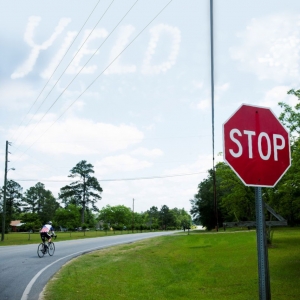
What is the answer for our large groups at stop signs when a YIELD or a full STOP is required by law?
See Oregon Bicycling Manual, Online Edition, ODOT, “Getting Started: Bicycling with Groups,” p. 6. This is Oregon law, “When riding as a group, everyone is considered to be a separate “vehicle.” This means that if you come to a stop sign or an intersection with a 4-way stop, each person riding must stop or yield separately. This might mean that the group has to pause or slow down to meet back up.”
Dave McQuery, Membership Secretary