
Safety: Avoid the Right Hook
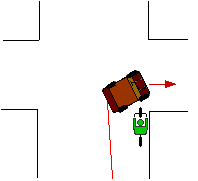 A car passes you and then tries to make a right turn directly in front of you, or turns right into you. They may think you’re not going very fast just because you’re on a bicycle, so it never occurs to them that they can’t pass you in time. Even if you have to slam on your brakes to avoid hitting them, they often won’t feel they’ve done anything wrong. This kind of collision is very hard to avoid because you typically don’t see it until the last second, and because there’s nowhere for you to go when it happens.
How to prevent this kind of collision:
Glance in your mirror before approaching an intersection. (If you don’t have a handlebar or helmet mirror, get one now.) Be sure to look in your mirror well before you get to the intersection. When you’re actually going through an intersection, you’ll need to be paying very close attention to what’s in front of you. ✎
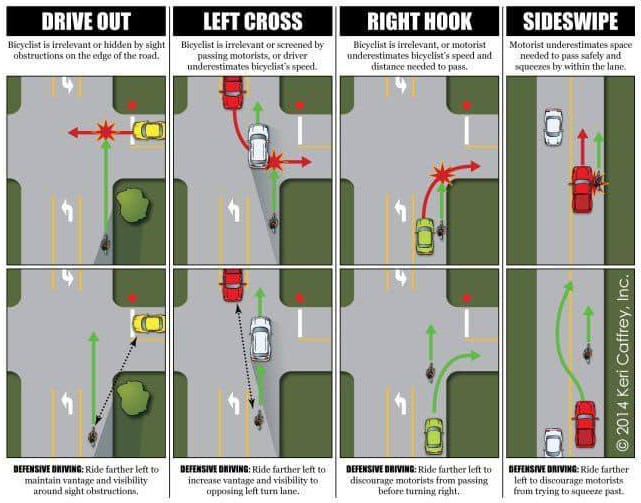
Ride to the left rather than hugging the right curb. Motorists can see you better if you’re squarely in the road rather than on the extreme edge where you’re easily overlooked. Don’t feel bad about taking the lane: if drivers didn’t threaten your life by turning in front of, or into you, or passing you too closely, then you wouldn’t need to take the lane. Taking up the whole lane makes it harder for drivers to pass you, to cut you off, or to turn into you. If the lane you’re in isn’t wide enough for cars to pass you safely, then you should be taking the whole lane anyway.
It’s perfectly legal for you to take the lane when appropriate. When you’re riding in a heavy traffic area with lots of side streets, parking lots, or driveways ahead and to your right, then move left. If the lane is too narrow for cars to pass you safely, then move left and take the whole lane. Getting buzzed by cars is dangerous. When cars are parked on the right-hand side of the road, ride far enough away that you don’t risk being hit by an opening car door.
You might worry about slowing down the traffic behind you if you take the lane, but if you’re on the kind of street where you’ve got cars blocked up behind you that can’t pass you or are constantly changing lanes to get around you, you’re probably riding on the wrong street and should find a different route.
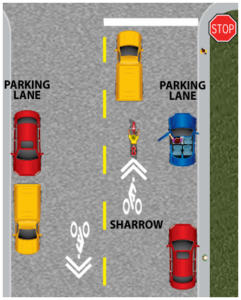
Where you choose to position yourself on the road depends on the street you’re on and the conditions of the roadway. In Oregon, if there is a bicycle lane on a street you are required to ride in it, with exceptions. When there is no bicycle lane, it is generally best to ride on the right. If there is no bicycle lane or shoulder and the vehicle travel lane is narrow, you should ride closer to the center of the traffic lane. On some streets a shared lane marking or “sharrow” is painted on the road to indicate that the lane is shared with people driving and people riding bicycles. Position yourself over the sharrow to make yourself more visible to drivers. Remember, ride to the left or take the lane when approaching intersections to avoid the right hook, checking your mirror first, of course, before you move left.
For more information about riding with traffic, whether to ride to the ride or take the lane, and passing other vehicles, go to Oregon Bicycling Manual, Online Edition (Section 5 – Rules of the Road, screens 20-23, pages 14-17).
All of these crashes are the motorists’ fault, but a bicyclist with the wisdom to ride defensively can hopefully avoid them:
The Safety Committee, excerpted from BicycleSafe.com