Safety: The Hidden Risks of Curb Extensions
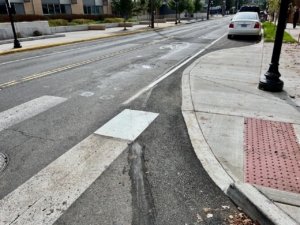 Bicycling is a healthy and environmentally friendly way to travel, but it’s not without its risks. A growing concern for cyclists is the unexpected impact of curb extensions, which can force bicyclists into traffic lanes with little or no warning. These design changes, often made to improve pedestrian safety, can inadvertently create hazardous situations for those on bicycles.
A Case in Gresham
One notable example of this issue is when you are riding eastbound on NW 12th Street toward N Main Avenue, approaching a T-intersection, across from Gresham High School. A clinic replaced an old house on the southwest corner at this location, prompting updates to the intersection, including new pedestrian safety features. While these updates aimed to protect pedestrians, they created challenges for cyclists.
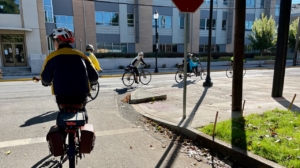
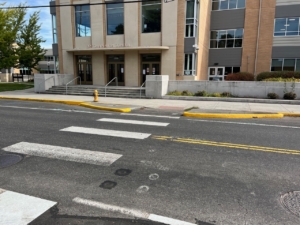 Several regular bike routes head east from the Wy’East Way Path, connecting Rockwood to downtown Gresham. Cyclists approaching the corner to turn southbound onto N. Main Ave. once enjoyed their own bike lane. Now, the newly added curb extension diverts bicyclists into the car traffic lane, creating a dilemma: merge into traffic or risk hitting the curb. ✎
The crosswalk, which has long connected the southwest corner to the school, now includes curb extensions on both sides of Main. As a result, bike lanes are interrupted in both directions, compelling cyclists to navigate with vehicle traffic.
In Gresham, fortunately, there are two possible solutions:
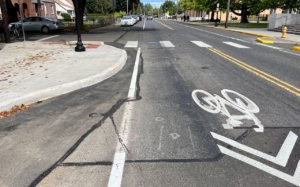 A shared lane marking or “sharrow” is painted on the road to indicate that the lane is shared with people driving and people riding bicycles. The sharrow symbol also indicates to the person riding a bicycle where they should be positioned – usually in the center of the lane or just right of center. This does still require that you stop at the STOP sign to check for traffic coming from your left before making a right turn and taking the lane. The traffic on Main is on a through street, without a STOP sign, and has the right of way. Bicycles on 12th are on a side street with a STOP sign, and if there is traffic, are required by law to yield. Remember, just because a rider in front of you proceeds doesn’t indicate that it’s clear for you. Oregon law considers you a separate “vehicle,” and you are responsible to assess the intersection for yourself.
- To avoid the curb extension dilemma, go around the back side of the block by making a right turn one block earlier onto NW Miller Avenue, then turning left onto NW 11th Street. Then you will have a clear right turn into the bike lane on N Main Avenue.
Another Example in Portland
A similar hazard exists in Portland on SE Stark Street between 82nd Avenue and 92nd Avenue, near the antique mall. There, curb extensions require both drivers and cyclists to remain highly vigilant, as both parties must adjust and look out for each other to avoid accidents.
A Call to Action for Safer Bicycling
 It is crucial for city planners, cyclists, and motorists to work together to address these risks. Bicyclists: always be aware of your surroundings, especially when approaching intersections with potential curb extensions. Drivers: stay alert and give cyclists adequate space when they are forced to merge into traffic lanes.
City officials and urban planners must consider the safety of all road users when implementing pedestrian-focused changes. Adding clear signage, bike lane markings, or alternative routes can help mitigate these risks.
Together, we can create safe streets for everyone – pedestrians, cyclists, and motorists alike. Advocate for bicycle-friendly designs in future infrastructure projects, and report hazardous intersections to the local transportation department.
Maria Sworske, Member at Large