Be Cautious When Passing Stopped Riders
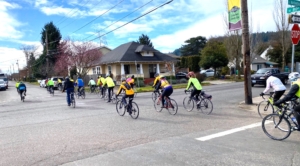 The board has recently received reports of, and some of us have personally observed, the unsafe practice of riders passing others who have stopped or are slowing down, especially at intersections with STOP signs. This behavior poses significant safety risks, and can be especially hazardous in high-traffic areas, though it is a potential danger anywhere on the road.
Even when riders at the front of the group have proceeded through an intersection, a rider farther back may stop for a variety of reasons: they may be inexperienced, cautious, or responding to something unexpected or to a change in the traffic pattern. For example, cars crossing at an intersection without a STOP sign have the right of way when you have a STOP sign, and you are required by law to stop. At a four-way stop, if a new car has stopped before you have, you are required by law to yield to the motorist. ✎ There may not have been cross traffic when the first riders went through the intersection. That doesn’t mean you can just follow without checking for yourself. Even if you believe it is safe to proceed, it may be risky. For everyone’s safety, we urge you to stop if the rider ahead of you has stopped at a STOP sign, particularly in areas with higher traffic. Oregon law requires cyclists to always yield the right of way at STOP signs, for motorists and for pedestrians.
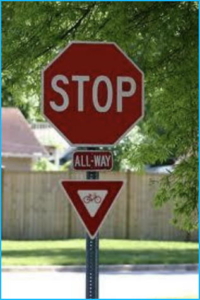 This issue is also one that influences public perception. Inconsistent riding behavior can lead to confusion or frustration among drivers who are already divided on the topic of cyclists sharing the road. If the driver was there first, STOP; you must yield to traffic. When there is no opposing traffic, you can roll through. Let’s prioritize safety and courtesy to present a unified, responsible message to the public.
Thank you for your cooperation and commitment to safety.
See Oregon Bicycling Manual, Online Edition, ODOT, “Getting Started: Bicycling with Groups,” p. 6. This is Oregon law: when riding as a group, everyone is considered to be a separate “vehicle.” This means that if you come to a STOP sign or an intersection with cross traffic (motorists, cyclists, or pedestrians, with or without STOP signs), each person riding in your group must separately consider stopping or yielding, depending on who has the right of way. The group may then have to pause or slow down to meet back up and regroup on the other side of the intersection.
Maria Sworske, Member at Large